CANDU 6 · visual walkthrough
From fuel to the grid.
Walk through the plant, open its machinery and get close to the surfaces. Follow the energy story or choose your own route.
A continuous visual story from the fuel to electricity.
authored time
Chapter still · preparing interactive view
Read the complete journey and its visual scope
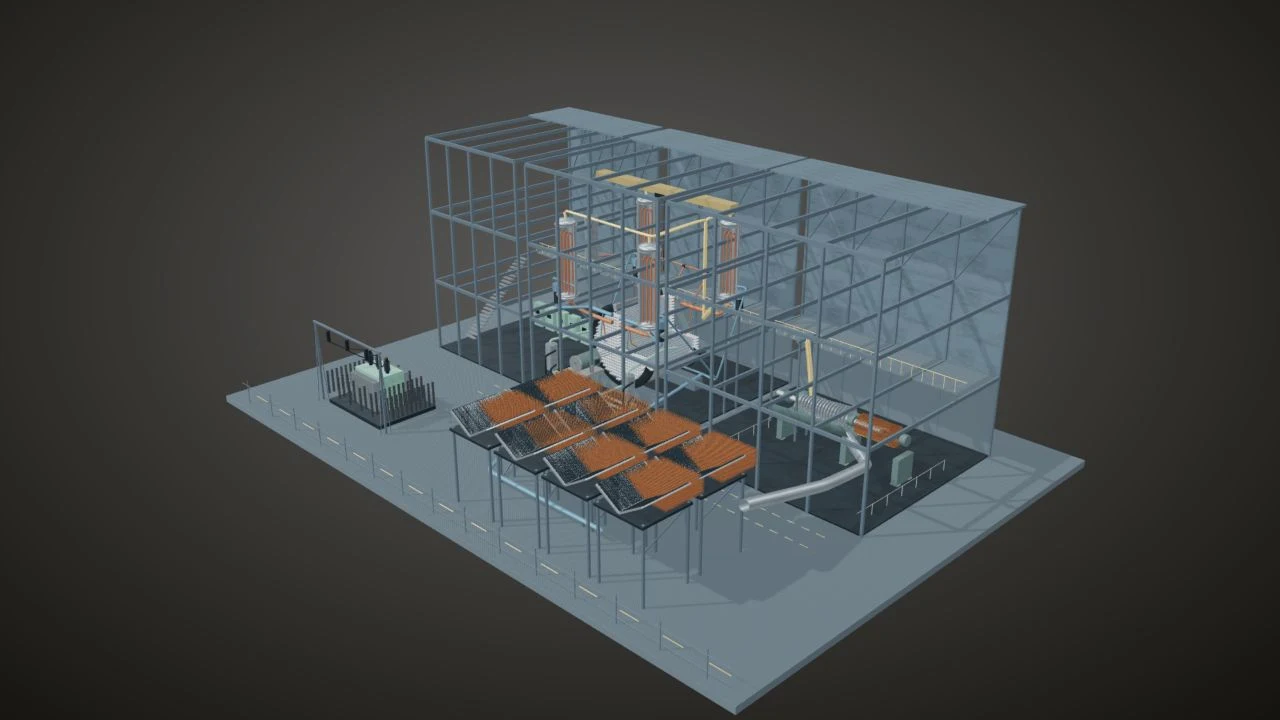
This is an authored CANDU 6 teaching environment. Hardware details, plant arrangement, wear, camera travel and animation timing are illustrative. It is not a station’s as-built model or a prediction of reactor behaviour. The reference geometry and source records remain available in the engineering workbench.
The plant
Start at the plant, then enter the fuel. The same warm cue will carry the story from fission through heat and motion to electricity.
Open this stopLoad fuel
A representative fuelling machine aligns with a horizontal fuel channel. The moving bundle and ram illustrate the loading direction; the choreography compresses a much more involved handling operation.
Open this stopFuel bundle
The cutaway separates the surrounding channel boundaries from the fuel bundle. End webs and bearing pads make the assembly readable. Move from this assembly to one representative fuel element.
Open this stopInside the fuel
The opened sheath reveals ceramic pellets. Travel inward to a deliberately enlarged diagram of a nucleus; the nuclear scene has no physical scale.
Open this stopA nucleus splits
An incoming neutron meets the nucleus. Two fragments separate and new neutrons leave. The colored spheres and their counts are diagram elements, not a specific isotope or measured event.
Open this stopThe reaction continues
Released neutron markers reach neighboring nuclei. This small, finite vignette makes the chain visible without representing multiplication, reactor control or physical time.
Open this stopFuel becomes heat
Pull back out of the diagram. A warm glow spreads through the pellet and toward its metal sheath. Color shows the direction of the story, not a temperature field.
Open this stopHeat enters coolant
Follow the warm cue into the water around the fuel elements. Coolant moves along the horizontal pressure tube; the surrounding moderator remains a separate inventory.
Open this stopPrimary heat
Follow the primary heavy-water circuit from the fuel channels through a steam generator and back through a pump. The moderator cooling circuit remains a separate inventory around the channels.
Open this stopAcross the tube wall
The primary coolant stays inside the steam-generator tubes. Heat crosses the metal wall to the secondary water. A moving halo makes the boundary visible; it does not show fluid crossing that wall.
Open this stopWater becomes steam
Bubbles grow and rise around the hot tubes, gathering into a steam plume above the water. These are authored phase-change cues. Follow the steam line toward the turbine.
Open this stopTurbine & generator
Steam drives the turbine stages and their shared shaft. Open the casing to inspect the blades and generator windings. The slow rotation makes the mechanism visible; it is an authored playback speed.
Open this stopMotion becomes electricity
The shaft turns the generator. A rotating field pattern and traveling electrical markers connect the mechanical motion to output. Their colors and timing are explanatory cues, not electromagnetic results.
Open this stopReject heat
Follow exhaust toward the illustrative air-cooled condenser bank. Fins, tubes and fans expose the heat-rejection side of the cycle. This inherited plant arrangement is visual context, not a station layout.
Open this stopReturn water
Condensate collects, passes through the feedwater train and returns to the steam generators. The animated return completes the secondary circuit without joining the primary coolant or moderator.
Open this stopTo the grid
End with the electrical connection while the secondary water cycle closes. The fuel, primary coolant, moderator and secondary water never become one traveling substance. Replay, scrub back or move onto the plant floor.
Open this stop