BWRX-300.
The BWRX-300 plant concept in 3D, drawn from the design's public description. Open a station from the list beside the view to see its real numbers next to it.
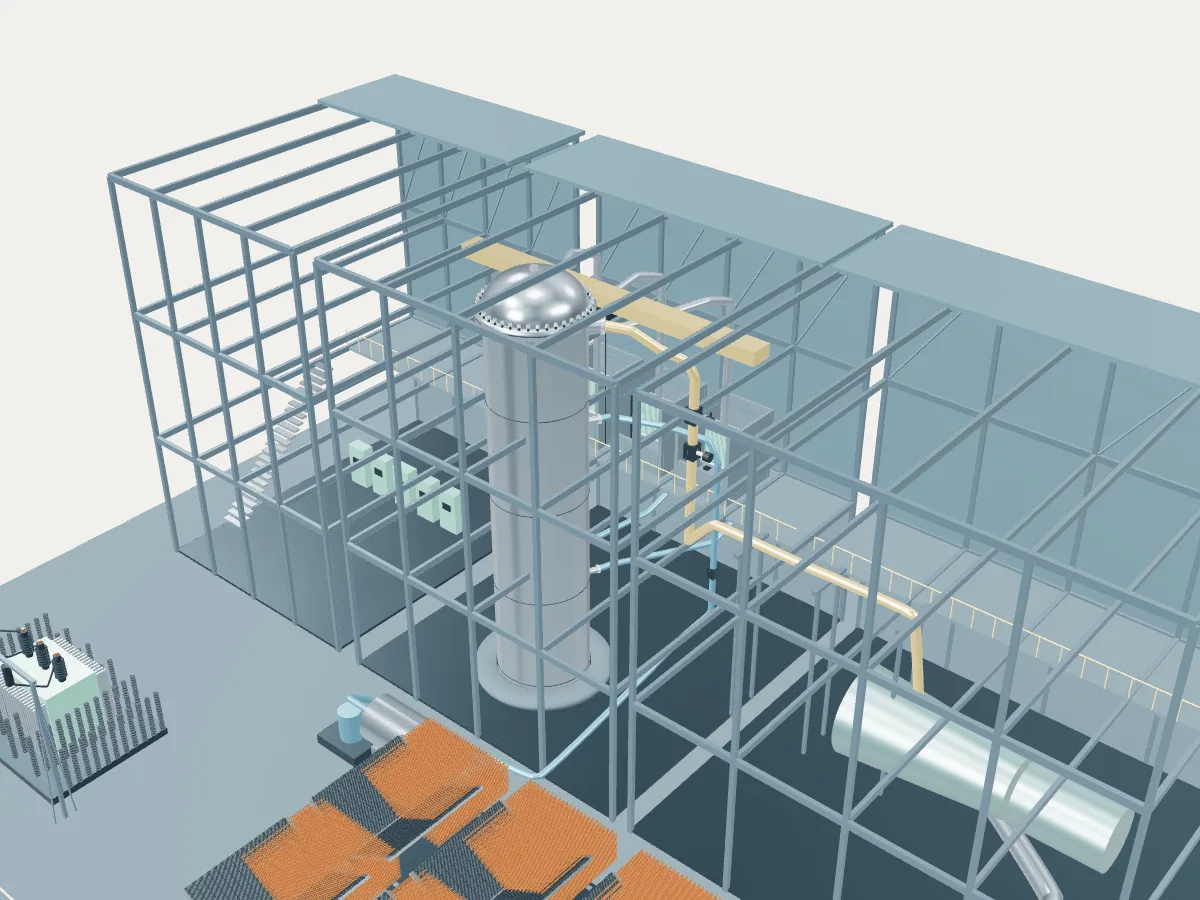 DESIGN CONCEPT · NOT A SIMULATION
The BWRX-300 plant concept.
The BWRX-300 design’s concept, not any one station. The model shows how a BWRX-300 plant works, drawn from the design’s public description, in the generic layout every design in the plant library shares: the reactor island, a turbine hall, air-cooled condensers and a grid connection. It does not show a real station's buildings, number of units, cooling or equipment.
The published design sets the reactor building below grade. The concept instead stands the vessel in the plant library's shared building frame, with its lower head under the slab and the isolation condenser pools on a mezzanine behind it.
A boiling water reactor of about 300 MWe. Water boils in the core and rises through a tall chimney, which keeps it circulating without recirculation pumps; separators and a dryer above send the steam straight to the turbine. Three isolation condenser trains give steam a second path: it condenses in tubes inside water pools and drains back to the vessel.
- Fuel
- Uranium dioxide
- Reaction
- Splitting heavy nuclei
- Energy transfer
- Direct cycle with natural circulation
Boiling water reactor
Water boils inside the reactor vessel and the steam goes straight to the turbine. One loop, no steam generators.
The BWRX-300 by its published numbers.
Each figure is the design’s own, as its source publishes it, with the page it is on. They describe the design, not any station: built units may be uprated, and the station’s own capacities are in its unit table. Nothing here is computed.
| Thermal power | 870 MWtGE Vernova Hitachi, BWRX-300 General Description, Rev. J, Table 2-1, p. 28 |
|---|---|
| Gross electric output | ~316 MWeGE Vernova Hitachi, BWRX-300 General Description, Rev. J, Table 2-1, p. 28 |
| Fuel bundles | 240GE Vernova Hitachi, BWRX-300 General Description, Rev. J, Table 2-1, p. 29 |
|---|---|
| Active core height | 3.8 mGE Vernova Hitachi, BWRX-300 General Description, Rev. J, §3.1.1, p. 31 |
| Control rods | 57, cruciform, fine-motion drivesGE Vernova Hitachi, BWRX-300 General Description, Rev. J, Table 2-1, p. 29 |
| Cycle length | 12–24 monthsGE Vernova Hitachi, BWRX-300 General Description, Rev. J, §4.3, p. 51 |
| Coolant circulation | Direct cycle, natural circulationGE Vernova Hitachi, BWRX-300 General Description, Rev. J, Table 2-1, p. 28 |
|---|---|
| Reactor operating pressure | 7.2 (absolute) MPaGE Vernova Hitachi, BWRX-300 General Description, Rev. J, Table 2-1, p. 28 |
| Vessel inside diameter | ≈4.2 (Table 2-1 rounds to 4) mGE Vernova Hitachi, BWRX-300 General Description, Rev. J, §3.1.1, p. 31; Table 2-1, p. 29 |
|---|---|
| Vessel inside height | ≈27.36 mGE Vernova Hitachi, BWRX-300 General Description, Rev. J, §3.1.1, p. 31 |
| Vessel wall, with cladding | ≈135.4 mmGE Vernova Hitachi, BWRX-300 General Description, Rev. J, §3.1.1, p. 31 |
| Primary containment | Steel-plate composite containment vesselGE Vernova Hitachi, BWRX-300 General Description, Rev. J, Table 2-1, p. 29 |
| Design life | 60 (extendable to 80) yearsGE Vernova Hitachi, BWRX-300 General Description, Rev. J, §17.1, p. 100 |
Where the BWRX-300’s heat goes.
One unit at its design rating, from the published figures above. Most of the reactor’s heat leaves through the condenser to the cooling water or air; the rest becomes electricity, some of which runs the plant itself. A figure marked “derived” is plain arithmetic on published ones; nothing is simulated.
- Reactor heat
- 870 MWtGE Vernova Hitachi, BWRX-300 General Description, Rev. J, Table 2-1, p. 28
- Gross electricity
- about 316 MWeGE Vernova Hitachi, BWRX-300 General Description, Rev. J, Table 2-1, p. 28
- Heat rejected through the condenser
- about 554 MWtDerived: 870 MWt of reactor heat less about 316 MWe gross
- 01 Heat source
- Reactor heat
- 870 MWtGE Vernova Hitachi, BWRX-300 General Description, Rev. J, Table 2-1, p. 28
- Reactor operating pressure
- 7.2 (absolute) MPaGE Vernova Hitachi, BWRX-300 General Description, Rev. J, Table 2-1, p. 28
- 02 Steam
- 03 Turbine and generator
- Gross electricity
- about 316 MWeGE Vernova Hitachi, BWRX-300 General Description, Rev. J, Table 2-1, p. 28
- 04 Cooling and return
- Heat rejected
- about 554 MWtDerived
- 05 Grid connection