Orion.
Orion at Malaga, Washington, beside the field-reversed configuration reference plant concept. The 3D model shows how the family works; it is not Orion's actual layout.
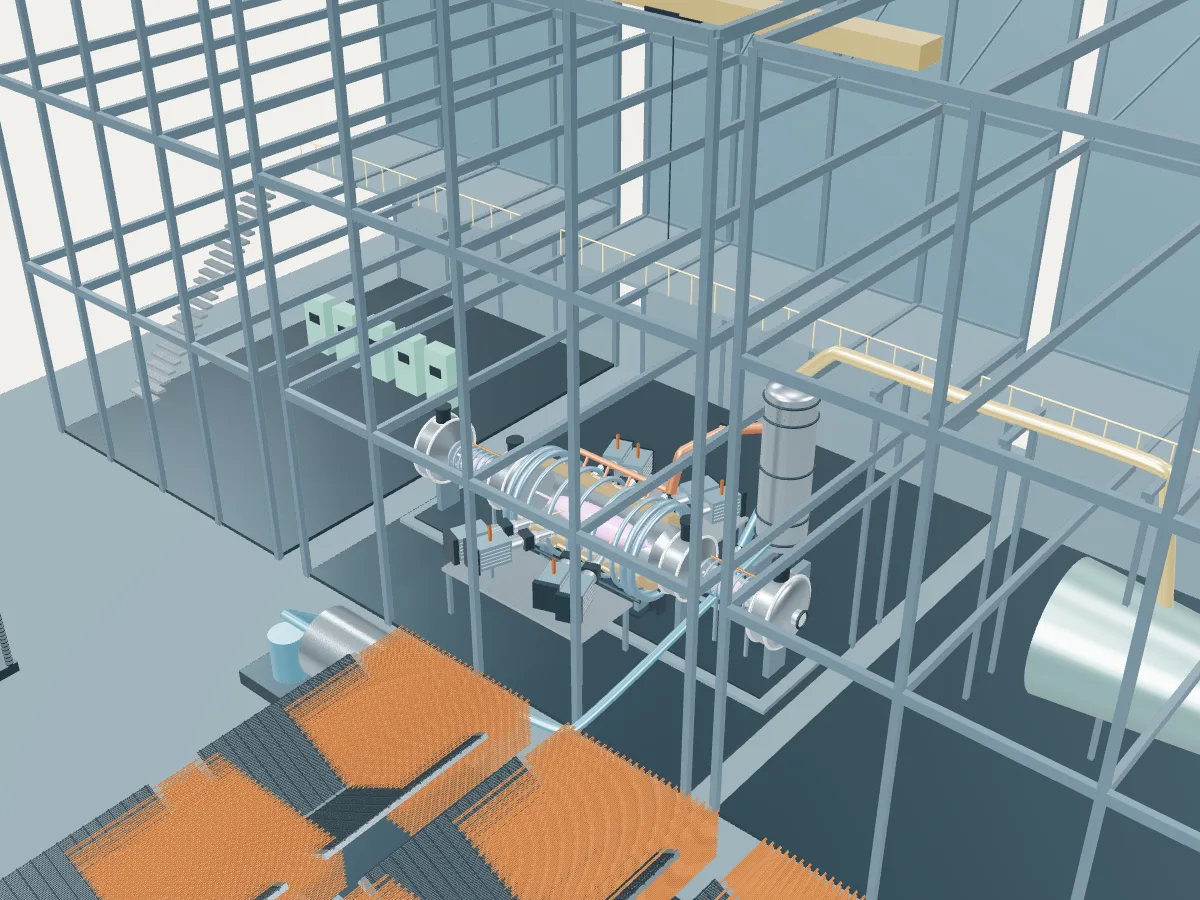 REFERENCE CONCEPT · NOT A SIMULATION
The field-reversed configuration reference plant.
The family’s reference concept, not Orion. The model illustrates a field-reversed configuration concept, with the generic layout every design in the plant library shares: the reactor island, a turbine hall, air-cooled condensers and a grid connection. It does not show Orion's buildings, number of units, cooling or equipment.
The map’s field-reversed devices follow two routes: TAE Technologies’ Norman and its successor Copernicus take the steady, beam-driven route drawn here, while Helion Energy’s Polaris and Orion merge and compress pulsed plasmas and propose recovering electricity directly from the plasma rather than through steam. Real machines are also longer than the drawing: Norman is about 30 m and Polaris about 19 m.
Two rings of plasma are formed in narrow tubes at the ends of a long machine, fired toward the middle and merged into one elongated, self-contained plasma in the central vessel. Angled neutral beams then heat and sustain it. In this conceptual plant, a blanket around the central vessel captures fusion heat, and a separate loop carries it to a heat exchanger that raises steam.
- Fuel
- Hydrogen-isotope plasma
- Reaction
- Combining light nuclei
- Energy transfer
- Blanket heat-transfer loop
Field-reversed configuration
A self-contained ring of plasma current that closes its own magnetic field, often formed and merged at high speed.