Junior.
Junior at Wellington, beside the levitated dipole reference plant concept. The 3D model shows how the family works; it is not Junior's actual layout.
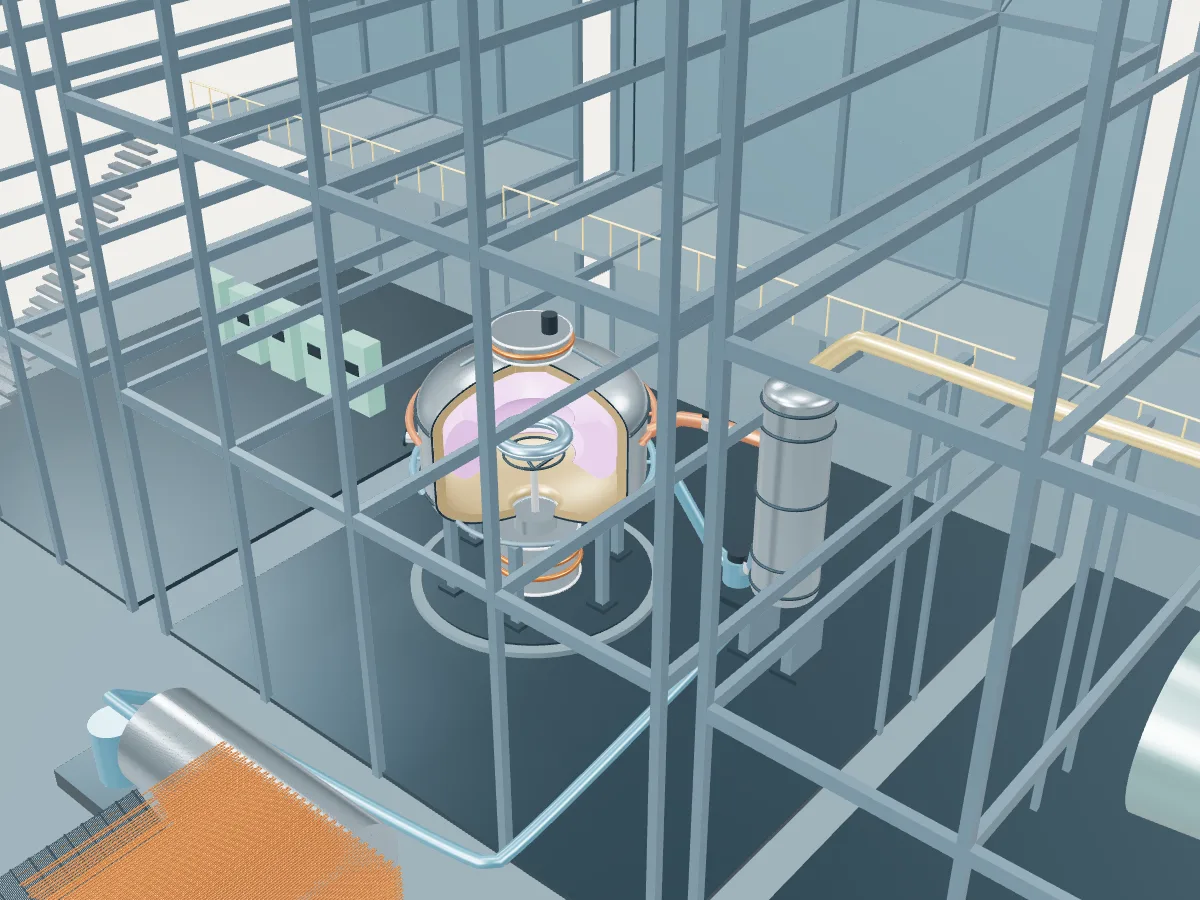 REFERENCE CONCEPT · NOT A SIMULATION
The levitated dipole reference plant.
The family’s reference concept, not Junior. The model illustrates a levitated dipole concept, with the generic layout every design in the plant library shares: the reactor island, a turbine hall, air-cooled condensers and a grid connection. It does not show Junior's buildings, number of units, cooling or equipment.
Levitated dipoles are at an early experimental stage: MIT and Columbia University’s LDX and OpenStar’s Junior, which reported first plasmas in late 2024, are research devices with chambers about 5 m across. Deuterium-deuterium fuel has been proposed for larger dipole devices, and the blanket and steam plant drawn here are conceptual.
A superconducting ring floats at the center of a large vacuum chamber, held up by a lifting coil above it. Its field holds a belt of plasma around it, the way a planet’s magnetic field holds its radiation belts. In this conceptual plant, a blanket lining the chamber wall captures fusion heat, and a separate loop carries it to a heat exchanger that raises steam.
- Fuel
- Deuterium-based plasma
- Reaction
- Combining light nuclei
- Energy transfer
- Chamber-wall blanket loop
Levitated dipole
A superconducting ring floats inside the chamber and holds plasma the way a planet's magnetic field holds its belts.