Pacific Fusion Demonstration System.
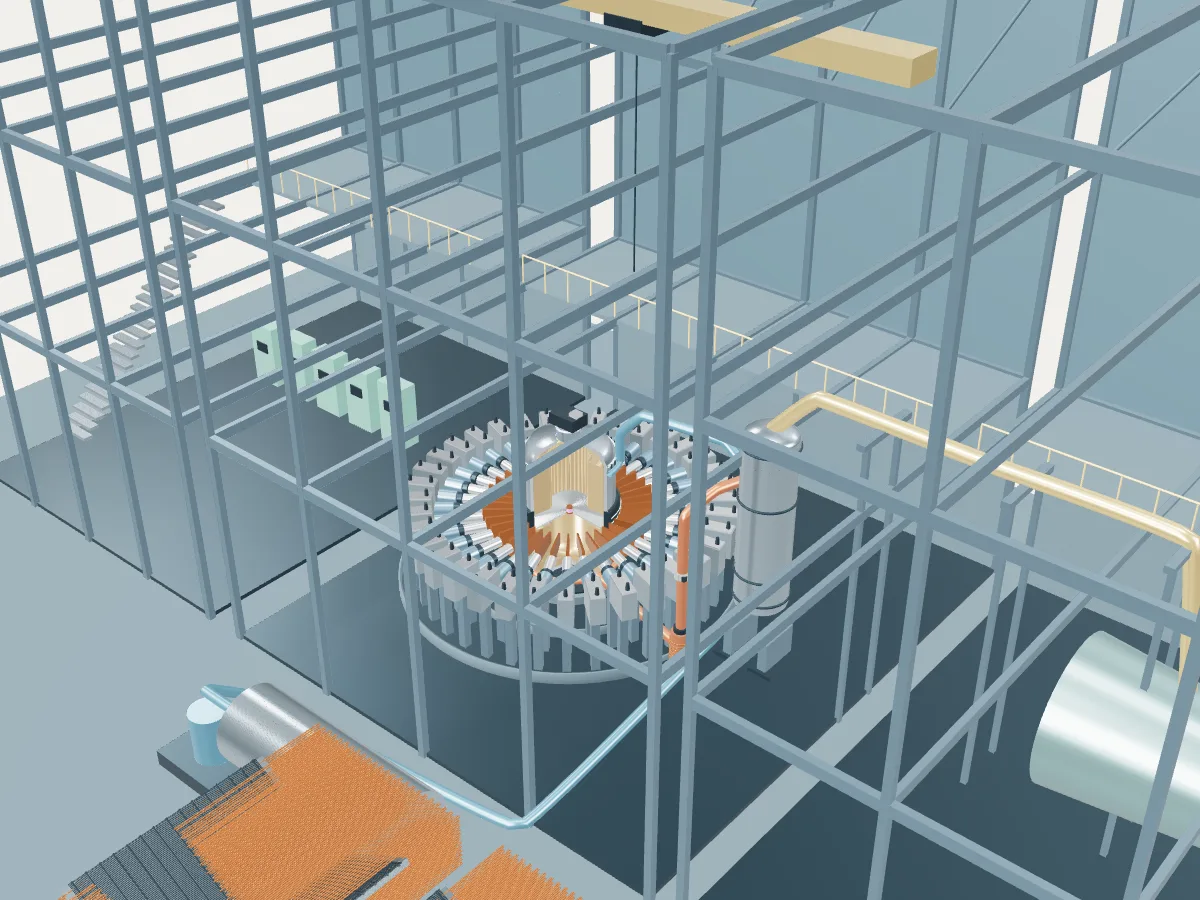
Pacific Fusion Demonstration System at Albuquerque (Mesa del Sol), beside the pulsed-power fusion reference plant concept. The 3D model shows how the family works; it is not Pacific Fusion Demonstration System's actual layout.
 REFERENCE CONCEPT · NOT A SIMULATION
The pulsed-power fusion reference plant.
The family’s reference concept, not Pacific Fusion Demonstration System. The model illustrates a pulsed-power fusion concept, with the generic layout every design in the plant library shares: the reactor island, a turbine hall, air-cooled condensers and a grid connection. It does not show Pacific Fusion Demonstration System's buildings, number of units, cooling or equipment.
The machines on the map are single-shot experiments, one still under construction, and their drivers differ: Z discharges Marx generators through water lines, Machine 3 serves projectile fusion, in which a fast projectile strikes the target, and the Pacific Fusion Demonstration System is built from impedance-matched Marx generator modules. None has produced net electricity, so the liquid-wall chamber and steam plant are conceptual.
A ring of pulsed-power modules stores electrical energy and releases it in one short, intense pulse. Transmission lines carry the current inward to a small target at the center of the chamber, and the current’s magnetic field crushes it. In this conceptual plant, a thick liquid wall inside the chamber absorbs the energy and carries the heat to a separate steam circuit.
- Target fuel
- Deuterium + tritium target
- Reaction
- Magnetically driven implosion
- Energy transfer
- Liquid-wall heat-transfer loop
Pulsed-power fusion
A huge, brief electrical pulse drives the implosion instead of lasers: tens of millions of amps in a fraction of a microsecond.