Haiyang.
5 AP1000 units at Haiyang, beside the AP1000 plant concept. The 3D model shows how the AP1000 design works; it is not Haiyang's actual layout.
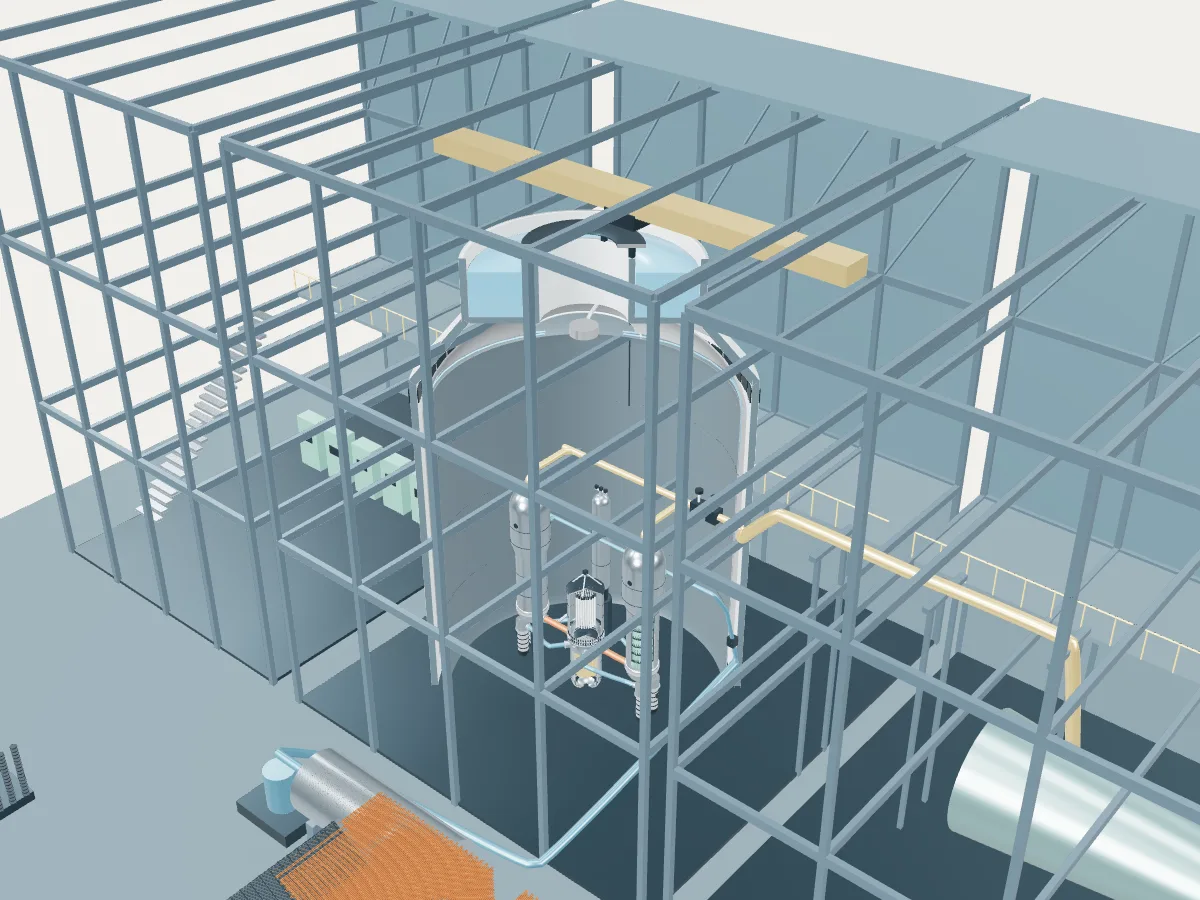 DESIGN CONCEPT · NOT A SIMULATION
The AP1000 plant concept.
The AP1000 design’s concept, not Haiyang. The model shows how an AP1000 plant works, drawn from the design’s public description, in the generic layout every design in the plant library shares: the reactor island, a turbine hall, air-cooled condensers and a grid connection. It does not show Haiyang's buildings, number of units, cooling or equipment.
The concept follows the AP1000 as certified. China’s CAP1000 units are a local standardization of it, built after the technology was transferred over the first four Chinese AP1000s, so their equipment and details may differ from what is drawn. Everything here, containment and cooling tank included, is drawn at 0.26 of full size, and the shared building frame stands in for the auxiliary and turbine buildings.
A two-loop pressurized water reactor of about 1,100 MWe. Water at 15.4 MPa carries heat from a 157-assembly core through two hot legs to two vertical U-tube steam generators, and four canned-motor pumps, hung upside down from the generators’ channel heads, send it back through four cold legs. Its safety systems need no pumps or AC power: after an accident, water drains from a tank on the shield building roof over the steel containment, and rising air carries the heat away.
- Fuel
- Uranium dioxide
- Reaction
- Splitting heavy nuclei
- Energy transfer
- Two-loop pressurized water primary circuit
Pressurized water reactor
Water held at around 155 bar stays liquid as it carries heat from the core to steam generators, where a second loop boils. The most common reactor on Earth.
The AP1000 by its published numbers.
Each figure is the design’s own, as its source publishes it, with the page it is on. They describe the design, not any station: built units may be uprated, and the station’s own capacities are in its unit table. Nothing here is computed.
| Thermal power | 3,400 MWtIAEA ARIS status report, Table 2, Single Core Thermal Power, p. 6 |
|---|---|
| Gross electric output | 1,200 MWeIAEA ARIS status report, §1 Overview, p. 1 |
| Net electric output | 1,100 MWeIAEA ARIS status report, §1 Overview, p. 1 |
| Turbine speed | 1,800 (1,500 for 50 Hz) rpmIAEA ARIS status report, §5.5 Secondary Side, p. 21 |
| Fuel assemblies | 157IAEA ARIS status report, Table 2, Number of Fuel Units, p. 6 |
|---|---|
| Assembly rod array | 17×17, squareIAEA ARIS status report, Table 1, Fuel Lattice Shape and Rods per Assembly, p. 3 |
| Fuel rods per assembly | 264IAEA-TECDOC-1391 (2004), §4.10.8 Technical data, Reactor core, printed p. 302 |
| Active core height | 4.267 mIAEA ARIS status report, Table 2, Active Core Height, p. 9 |
| Equivalent core diameter | 3.04 mIAEA ARIS status report, Table 2, Equivalent Core Diameter, p. 9 |
| Control rods | 69 (53 black, 16 gray)IAEA-TECDOC-1391 (2004), §4.10.8 Technical data, Reactor core, printed p. 302 |
| Uranium loading (initial core) | ~87,000 kgUIAEA ARIS status report, Table 2, Total Fissile Loading, p. 6 |
| Enrichment, average/maximum (18-month equilibrium reload) | 4.54/4.95 %IAEA ARIS status report, Table 2, Enrichment, p. 6 |
| Refueling cycle | 18 (12 or 24 also possible) monthsIAEA ARIS status report, Table 2, Refuelling Cycle, p. 6 |
| Coolant loops | 2 (each one hot leg, two cold legs)IAEA ARIS status report, Table 1, NSSS Layout, p. 3; §5.1, p. 15 |
|---|---|
| Steam generators | 2, vertical U-tubeIAEA ARIS status report, Table 2, Steam Generator Design, p. 6; §5.1, p. 15 |
| Reactor coolant pumps | 4, canned motor (sealless), two on each steam generatorIAEA ARIS status report, Table 1, Primary Circulation, p. 3; §5.1, p. 15; p. 22 |
| Primary pressure | 15.4 MPaIAEA ARIS status report, Table 2, NSSS Operating Pressure (primary side), p. 5 |
| Primary coolant flow | 15,120 kg/sIAEA ARIS status report, Table 2, Nominal Coolant Flow Rate (primary), p. 5 |
| Core inlet temperature | 280.7 °CIAEA ARIS status report, Table 2, Core Inlet Coolant Temperature, p. 5 |
| Core outlet temperature | 321.1 °CIAEA ARIS status report, Table 2, Core Outlet Coolant Temperature, p. 5 |
| Steam pressure | 5.76 MPaIAEA ARIS status report, Table 2, System Steam Pressure, p. 9 |
|---|---|
| Steam temperature | 272.8 °CIAEA ARIS status report, Table 2, System Steam Temperature, p. 9 |
| Steam flow | 1,889 kg/sIAEA ARIS status report, Table 2, System Steam Flow Rate, p. 9 |
| Feedwater temperature | 226.7 °CIAEA ARIS status report, Table 2, System Feedwater Temperature, p. 9 |
| Vessel inside diameter (core region) | ~4.039 mIAEA ARIS status report, §5.1 Primary Circuit, p. 15 |
|---|---|
| Vessel length | ~12.0 mIAEA ARIS status report, §5.1 Primary Circuit, p. 15 |
| Vessel shell wall | 203 mmIAEA-TECDOC-1391 (2004), §4.10.8 Technical data, Reactor pressure vessel, printed p. 302 |
| Containment | Free-standing steel vessel, 39.624 m diameter, 65.634 m high, 44.45 mm wall, cooled passivelyIAEA ARIS status report, §5.6 Containment/Confinement, p. 21; §5.4, p. 20 |
| Design life | 60 yearsIAEA ARIS status report, Table 2, Design Life, p. 4 |
Where the AP1000’s heat goes.
One unit at its design rating, from the published figures above. Most of the reactor’s heat leaves through the condenser to the cooling water or air; the rest becomes electricity, some of which runs the plant itself. A figure marked “derived” is plain arithmetic on published ones; nothing is simulated.
- Reactor heat
- 3,400 MWtIAEA ARIS status report, Table 2, Single Core Thermal Power, p. 6
- Gross electricity
- 1,200 MWeIAEA ARIS status report, §1 Overview, p. 1
- Net to the grid
- 1,100 MWeIAEA ARIS status report, §1 Overview, p. 1
- Used in the plant
- 100 MWeDerived: 1,200 MWe gross less 1,100 MWe net
- Heat rejected through the condenser
- 2,200 MWtDerived: 3,400 MWt of reactor heat less 1,200 MWe gross
- Net efficiency
- about 32.4 %Derived: 1,100 MWe net of 3,400 MWt
- 01 Heat source
- Reactor heat
- 3,400 MWtIAEA ARIS status report, Table 2, Single Core Thermal Power, p. 6
- Primary pressure
- 15.4 MPaIAEA ARIS status report, Table 2, NSSS Operating Pressure (primary side), p. 5
- Core inlet to outlet
- 280.7 → 321.1 °CIAEA ARIS status report, Table 2, Core Outlet Coolant Temperature, p. 5
- Primary coolant flow
- 15,120 kg/sIAEA ARIS status report, Table 2, Nominal Coolant Flow Rate (primary), p. 5
- 02 Steam
- Steam generators
- 2, vertical U-tubeIAEA ARIS status report, Table 2, Steam Generator Design, p. 6; §5.1, p. 15
- Steam pressure
- 5.76 MPaIAEA ARIS status report, Table 2, System Steam Pressure, p. 9
- Steam temperature
- 272.8 °CIAEA ARIS status report, Table 2, System Steam Temperature, p. 9
- Steam flow
- 1,889 kg/sIAEA ARIS status report, Table 2, System Steam Flow Rate, p. 9
- 03 Turbine and generator
- Gross electricity
- 1,200 MWeIAEA ARIS status report, §1 Overview, p. 1
- Turbine speed
- 1,800 (1,500 for 50 Hz) rpmIAEA ARIS status report, §5.5 Secondary Side, p. 21
- 04 Cooling and return
- Heat rejected
- 2,200 MWtDerived
- Feedwater temperature
- 226.7 °CIAEA ARIS status report, Table 2, System Feedwater Temperature, p. 9
- 05 Grid connection
- Net to the grid
- 1,100 MWeIAEA ARIS status report, §1 Overview, p. 1
- Used in the plant
- 100 MWeDerived
- Net efficiency
- about 32.4 %Derived
Haiyang’s 2 operating AP1000 units at design rating
Together they would take 6,800 MWt of heat from their reactors and reject 4,400 MWt to their cooling. Their own published net capacities add to 2,252 MWe.
Haiyang as one power plant.
Every unit on the site, from the atlas’s unit records: each reactor drives its own generator, which feeds the station’s switchyard and the grid. This is a schematic of how the units connect, not the station’s layout; the atlas records no buildings, cooling, switchyard arrangement or grid voltage.
- Operating · 2
- Under construction · 3
- On this page
- Operating
- 2 units · 2,252 MWe netPublished net capacities, from the unit table
- Being built or planned
- 3 units · 3,483 MWe net
- Heat at design rating
- 6,800 MWt in, 4,400 MWt rejectedDerived: 2 operating units of a named design, each at its design’s published rating
- Plant concepts here
- AP1000 (5)