HL-3 (HL-2M).
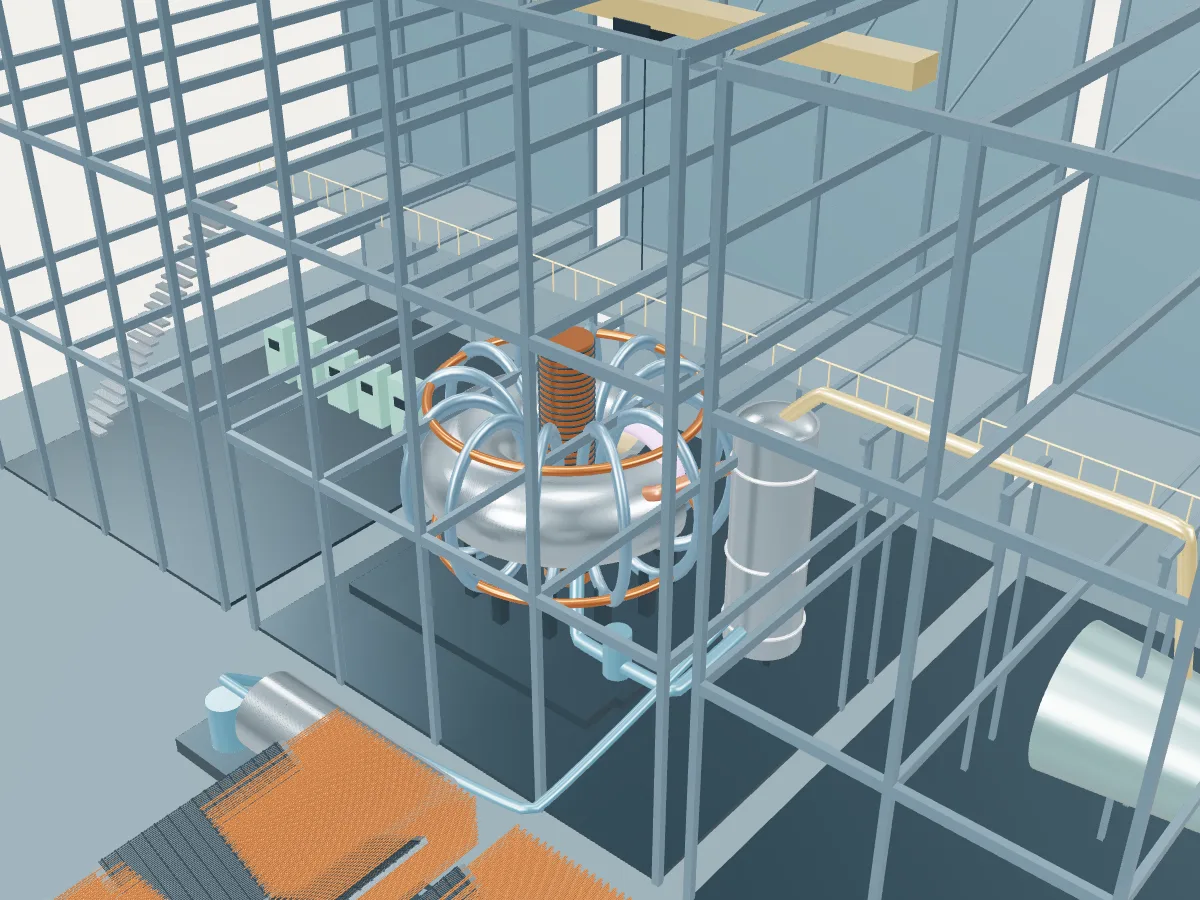
HL-3 (HL-2M) at Chengdu, beside the tokamak reference plant concept. The 3D model shows how the family works; it is not HL-3 (HL-2M)'s actual layout.
 REFERENCE CONCEPT · NOT A SIMULATION
The tokamak reference plant.
The family’s reference concept, not HL-3 (HL-2M). The model illustrates a tokamak concept, with the generic layout every design in the plant library shares: the reactor island, a turbine hall, air-cooled condensers and a grid connection. It does not show HL-3 (HL-2M)'s buildings, number of units, cooling or equipment.
Magnetic fields confine a ring of plasma. In this conceptual plant, a surrounding blanket captures fusion heat and transfers it to a separate steam circuit.
- Fuel
- Deuterium + tritium
- Reaction
- Combining light nuclei
- Energy transfer
- Blanket heat-transfer loop
Tokamak
A doughnut of plasma held by strong magnetic coils plus a current driven through the plasma itself. The most studied route to fusion power.