Chernobyl.
4 LWGR units at Chernobyl, beside the graphite-moderated boiling water reference plant concept. The 3D model shows how the family works; it is not Chernobyl's actual layout.
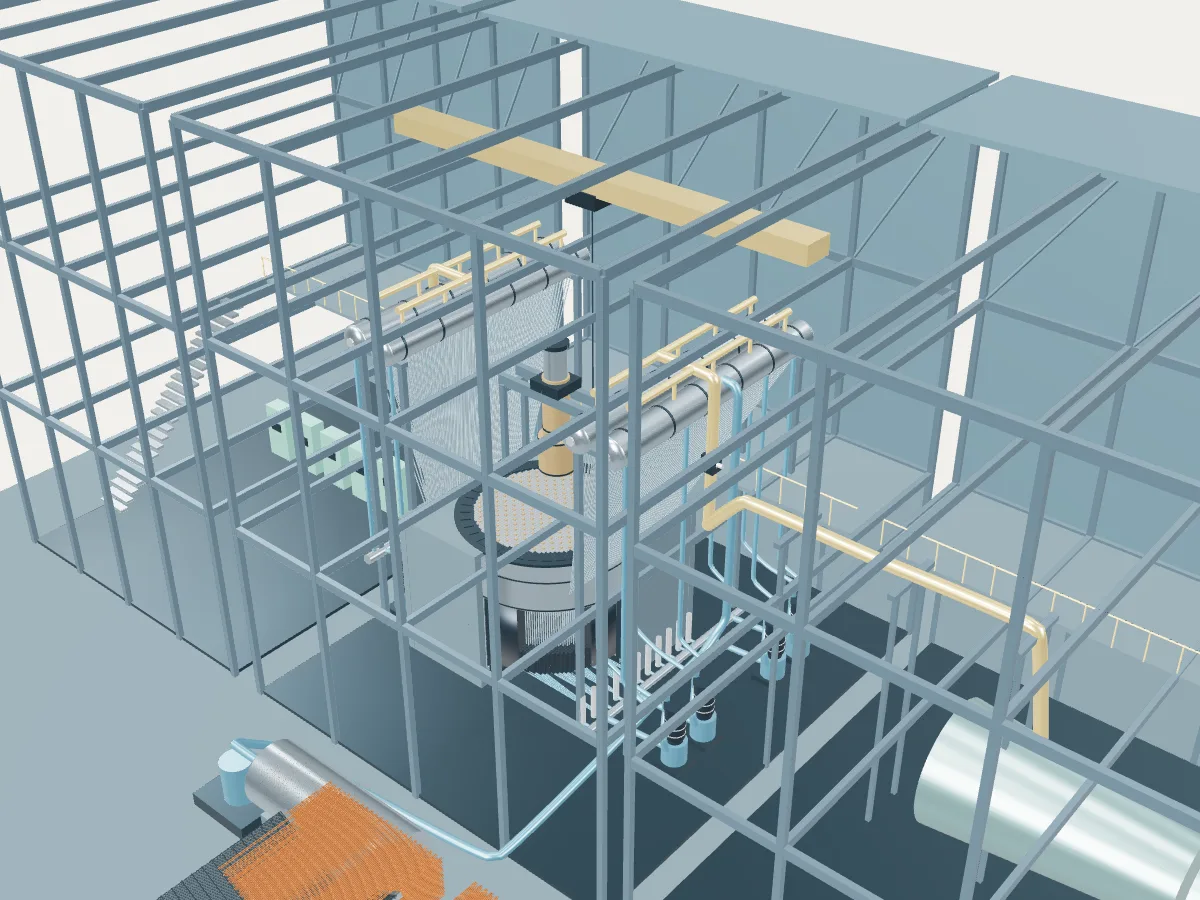 REFERENCE CONCEPT · NOT A SIMULATION
The graphite-moderated boiling water reference plant.
The family’s reference concept, not Chernobyl. The model illustrates a graphite-moderated boiling water reactor concept, with the generic layout every design in the plant library shares: the reactor island, a turbine hall, air-cooled condensers and a grid connection. It does not show Chernobyl's buildings, number of units, cooling or equipment.
The concept is an RBMK-1000; the RBMK-1500 keeps the same layout at higher power, while the early AM-1 and AMB units and the EGP-6 heat-and-power units at Bilibino are far smaller. After 1986 the operating RBMKs were modified with higher-enriched fuel, extra fixed absorbers and faster shutdown rods.
Water boils as it rises through 1,661 vertical fuel channels in a large graphite stack that slows the neutrons. Each channel sends its steam-water mixture up its own pipe to horizontal drums that separate the steam for the turbine, while pumps return the water to the bottoms of the channels. A machine on the top floor can change fuel while the reactor runs.
- Fuel
- Low-enriched uranium dioxide
- Reaction
- Splitting heavy nuclei
- Energy transfer
- Direct cycle: water boils in the fuel channels
Graphite-moderated boiling water reactor
A graphite stack moderates while boiling water cools fuel channels. The Soviet RBMK family; the last few run in Russia.
Chernobyl as one power plant.
Every unit on the site, from the atlas’s unit records: each reactor drives its own generator, which feeds the station’s switchyard and the grid. This is a schematic of how the units connect, not the station’s layout; the atlas records no buildings, cooling, switchyard arrangement or grid voltage.
- Shut down · 4
- On this page
- Operating
- None
- Shut down
- 4 units · 3,700 MWe net
- Plant concepts here
- LWGR reference (4)