← All scenes
GEOMETRY ONLY · OPENUSD
Blanket sector: exact geometry of a generic tokamak wall.
A 60-degree sector of a generic tokamak blanket, built as exact solids from a radial build: first wall, breeding zone, back plate, shield and vacuum vessel around a circular plasma. Geometry only. No field is shown because no solver has run on it. The volumes come from the exact solids.
SCENE OF RECORDDISPLAY ONLY · NEVER SOLVER INPUT
The run as one scene
A 60-degree sector of a generic tokamak blanket, built as exact solids from a radial build: first wall, breeding zone, back plate, shield and vacuum vessel around a circular plasma. Geometry only. No field is shown because no solver has run on it. The volumes come from the exact solids.
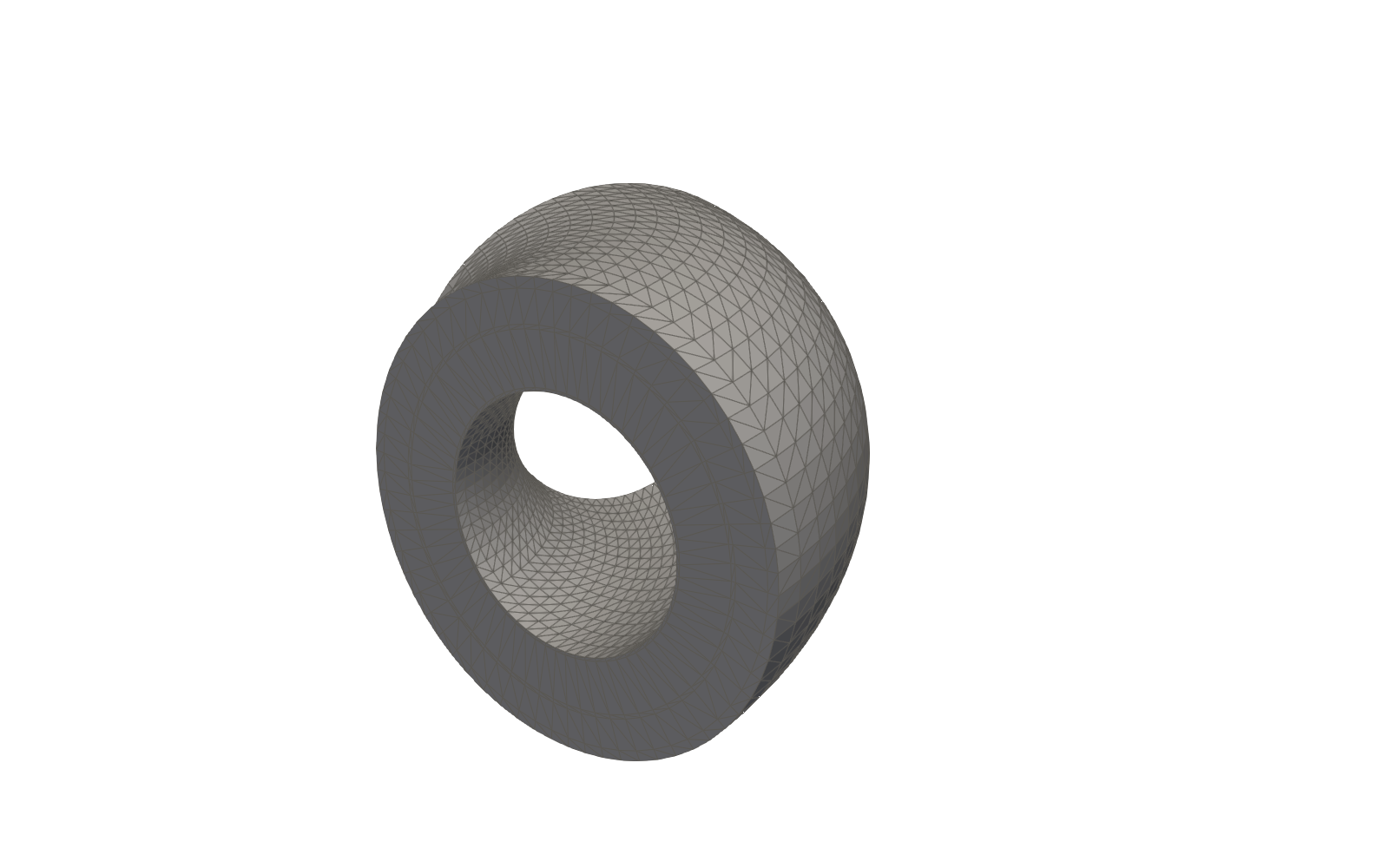
A still from ParaView. Load 3D to turn the scene and select parts.
Take it with you
Download scene.usdz (193 KB) ↓Download for ParaView (642 KB) ↓Download scene.usda and its layers (84 KB) ↓
Receipt
- Geometry
- NVIDIA USD BRep 1.0.0 (exact solids and the display mesh). OpenUSD 0.26.8. Units: m.
- Result layers
- ParaView 6.2, exported headless on the runner.
- Second kernel
- The same radial build built again in OpenCascade: CadQuery 2.8.0 (exact annulus revolve) and Paramak 0.10.0 (spline profile). Largest difference from the USD BRep volumes 0.0024%; CadQuery against the closed form 5.8e-14; Paramak against the closed form 4.6e-7. Checked 2026-10-16T20:46:37Z on Linux-6.8.0-1064-azure-x86_64-with-glibc2.35. Passed.
- Made
- 2026-10-15T11:42:23Z, workflow run 38728950747 ↗.
Rules this scene keeps
- Geometry is for display, never solver input. No solver has used these solids.
- No field is shown. A field appears only when a real run of a documented model computes it.
- The dimensions are a generic radial build chosen for teaching, not a design.
- The volumes are computed from the exact B-rep solids by NVIDIA USD BRep and cross-checked against the same radial build in CadQuery (OpenCascade).