PWR
Pressurized water reactor
Water held at around 155 bar stays liquid as it carries heat from the core to steam generators, where a second loop boils. The most common reactor on Earth.
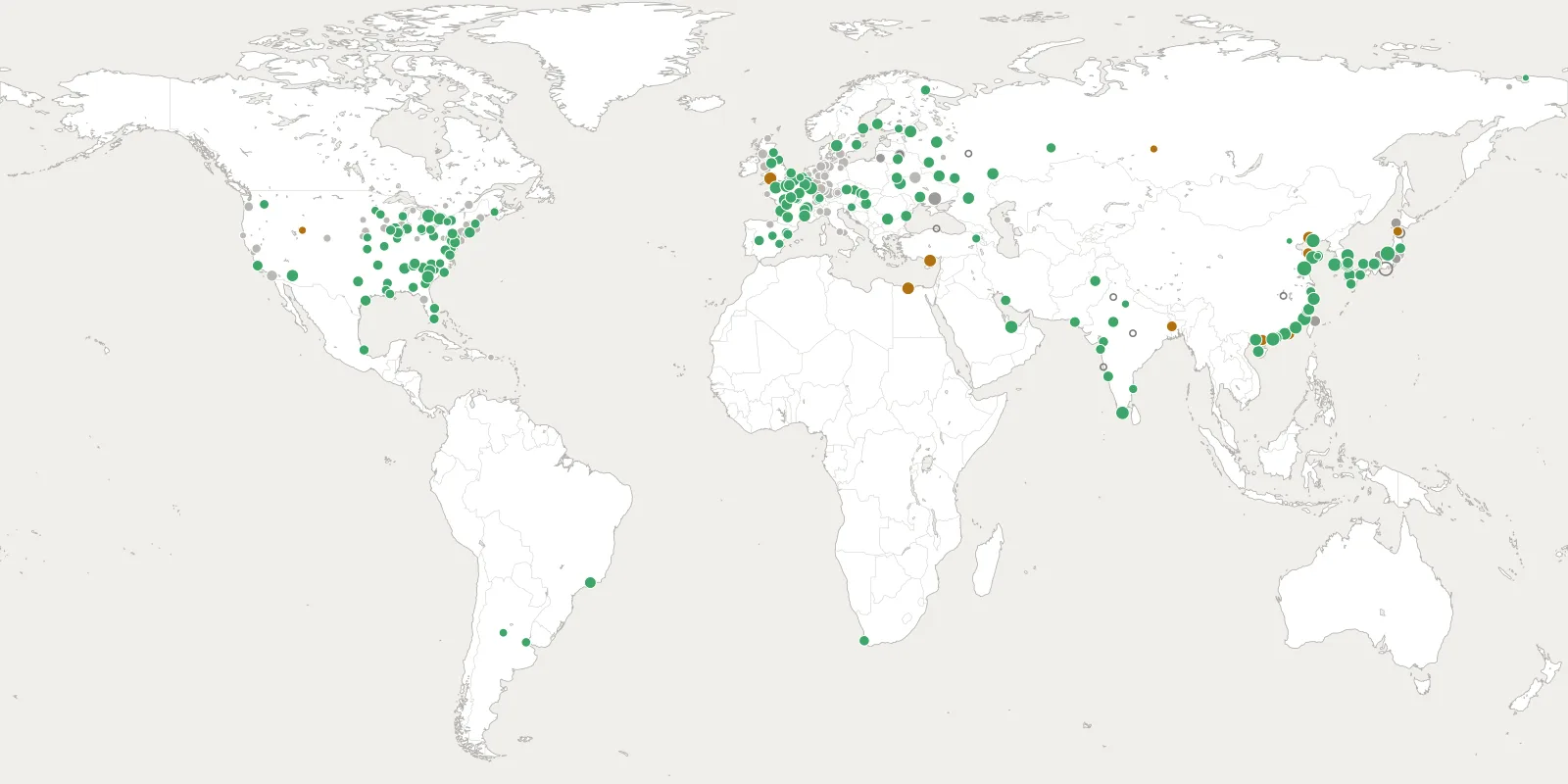
792 power reactors and 97 fusion machines, from the first grid-connected units to the plants being built today. Turn the globe, switch between fission and fusion, and learn to tell a PWR from a stellarator.
Water held at around 155 bar stays liquid as it carries heat from the core to steam generators, where a second loop boils. The most common reactor on Earth.
Water boils inside the reactor vessel and the steam goes straight to the turbine. One loop, no steam generators.
Heavy water slows neutrons well enough to burn natural uranium. Fuel sits in hundreds of horizontal pressure tubes and is refuelled while running.
A graphite stack moderates while boiling water cools fuel channels. The Soviet RBMK family; the last few run in Russia.
Carbon dioxide cools natural-uranium metal fuel in a graphite core. The first generation of British and French power stations, now all retired.
Britain's second generation: still CO2 and graphite, but enriched oxide fuel at higher temperature for better efficiency.
No moderator. Liquid sodium cools a compact core of fast neutrons that can breed more fuel than it burns.
Helium removes heat from coated-particle fuel in graphite. Designs may use pebble beds or prismatic blocks. The linked two-module pebble-bed reference is one arrangement, not a model for every HTGR, AGR or gas-cooled reactor.
Explore a family example: HTR-PM · 2016 demonstration design basis
Molten lead cools a fast-neutron core. It boils at 1,749 °C, so the coolant never needs to be pressurized.
One-off designs that fed the grid: heavy-water gas- and organic-cooled units, steam-generating heavy water, sodium-graphite.
Power reactors are listed unit by unit and grouped into stations; each unit links to its record in the IAEA Power Reactor Information System. Fusion entries are experiments, test machines and announced plants with a named site. Every fusion device, and every change made since the base dataset, cites the public page it was drawn from. Capacities are net electrical output.
Naming a facility or company here cites a public record; it does not imply a partnership, customer relationship or endorsement. This is a reference map, not a simulation and not an engineering dataset. Data current to 2026-11-06. Spotted something out of date? Tell us.